Why Doing Less Will Make You More Money
Mar 02, 2026
A few years ago, a client came to me with four online courses, three lead magnets, two webinar funnels and a membership site. On paper it looked like a thriving business. Monthly revenue sat at around $22,000, and they were working every evening and most weekends to keep it all running. Their family mostly saw the back of their head while they stared at a laptop.
We cut it right back. They kept one flagship course, one lead magnet and one simple way of selling it, and everything else was paused.
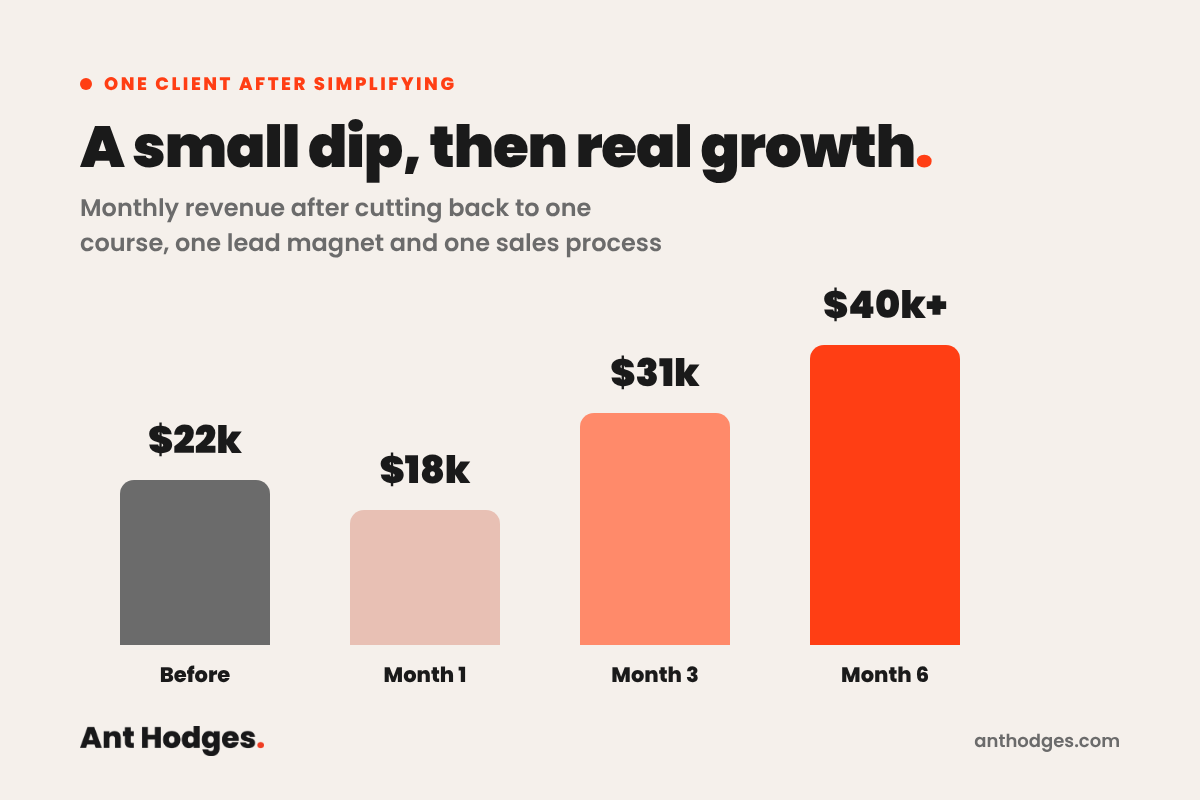
The first month was uncomfortable. Revenue dipped to $18,000, and I could hear the worry in their voice on our calls. By month three it had reached $31,000. By month six it was consistently above $40,000 every month, and the evenings and weekends were theirs again.
That pattern no longer surprises me. When business owners strip back to the few things that really work, revenue usually goes up, and their life gets better at the same time.
This post explains exactly why it happens. You'll see the research on why our brains reach for more, what busyness actually costs, what happened when 61 companies tried working less, and a simple way to choose what to cut first.
The short answer
Doing less makes more money because focus compounds. When you cut your business back to one core offer, one main channel and the few activities that produce revenue, your buyers find it easier to say yes and you put your best energy into the work that pays. Research shows people instinctively solve problems by adding, and that switching between tasks can cost up to 40% of productive time. The fastest growth often starts by removing things, accepting a short dip, and then backing what works.
In this post
- Why does doing less make you more money?
- Why do we always add instead of subtract?
- What is the Subtraction Principle?
- What does being busy really cost your business?
- Can you work less and keep your revenue?
- The pruning principle: why growth needs cutting back
- Where should you start subtracting?
- How do you decide what to cut?
- What happens when you only use what you already have?
- How do you stop the clutter creeping back?
- Try this today: the two-things question
- Frequently asked questions
Why does doing less make you more money?
It sounds backwards, so it helps to look at where the money in a small business really comes from. Most online businesses earn the bulk of their revenue from a handful of things: one offer that sells well, one channel that brings the right people, and a few conversations that turn interest into sales.
Everything else competes with those things for the same limited supply of your time, energy and attention. When you add an offer, a platform or a funnel, you rarely add a new source of money. More often, you take focus away from the source you already had.
Doing less works in three ways at once.
Your buyers find it easier to decide. One clear offer with one clear next step is far easier to say yes to than a menu of six options that all sound similar.
Your best work goes where it counts. With fewer things to run, you have the energy to improve the offer, show up in conversations and look after the clients you already have.
Your costs fall as your results rise. Fewer tools, fewer projects and fewer half-finished ideas mean less money and time leaking out of the business every month.
That combination is why stripping back so often leads to growth. The business stops spreading itself thin and starts pulling in one direction.
Why do we always add instead of subtract?
If subtraction works so well, why is it so rare? Part of the answer is how our brains are wired.
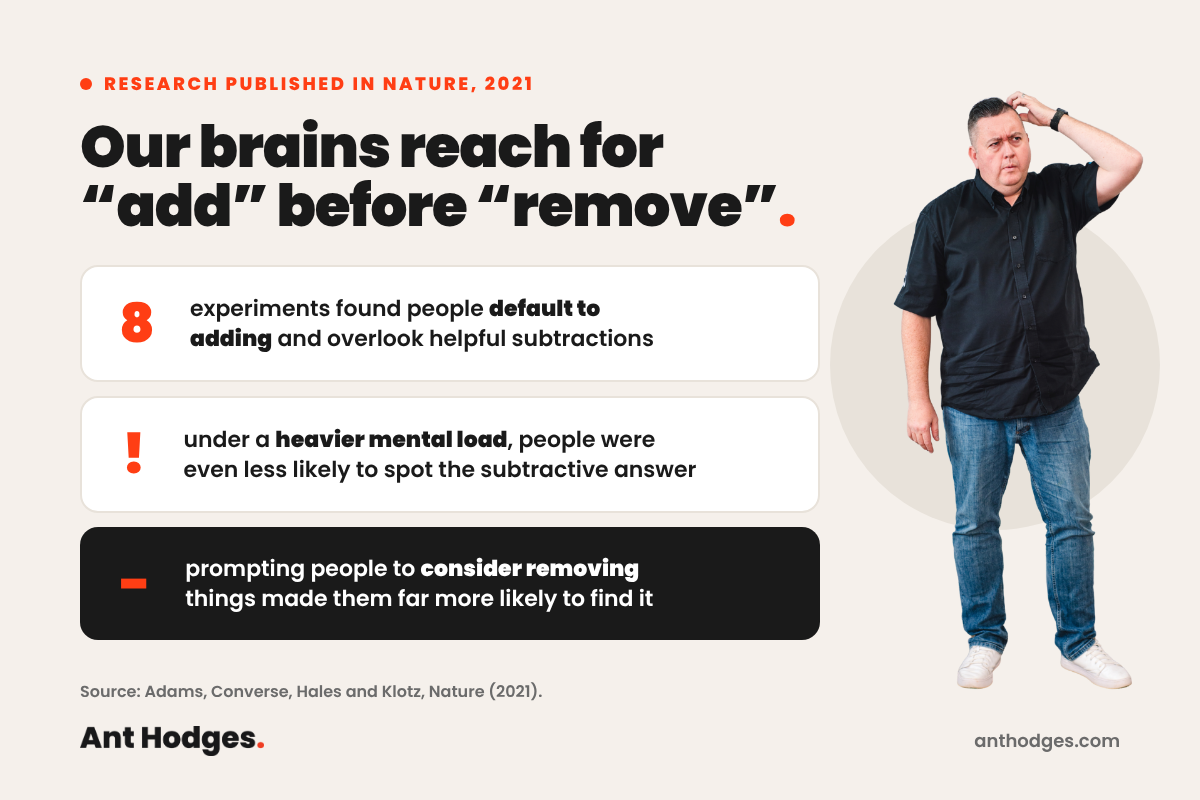
In 2021, a team of researchers at the University of Virginia published a study in Nature on how people improve things. Across eight experiments, they found that people systematically default to adding new parts, and overlook changes that take something away.1 People were more likely to spot a helpful subtraction when they were prompted to look for one, or when they had several chances to notice that adding wasn't working.
One finding stands out for busy business owners. Participants under a heavier mental load were even less likely to see the subtractive answer.1 The authors suggest this default may be one reason people struggle with overloaded schedules and red tape.
Put that next to the reality of running a business. The busier and more stretched you are, the more likely you are to solve the next problem by adding something else. Then the extra thing makes you busier still, and the cycle repeats.
The online business world doesn't help. Every week brings a new platform, tactic or launch method, and each one is sold as the missing piece. The belief behind it has a name, and the one I use is the cult of hustle: the idea that effort and volume are what drive success. Breaking the cycle starts with one deliberate question.
What is the Subtraction Principle?
The question I ask clients, and myself, is simple. Before you add anything new, ask what you can remove. My name for it is the Subtraction Principle.
Definition
The Subtraction Principle
The Subtraction Principle is a rule taught by Ant Hodges, author of Simplify the Funnel®. It says that before adding anything new to a business, an owner should first ask what can be removed. It targets the activities, offers and tools that take time without being directly connected to revenue.
In practice, the Subtraction Principle comes down to three follow-up questions.
- What isn't directly connected to revenue?
- What takes time but doesn't produce results?
- What exists only because you started it once and never stopped to ask whether it's still worth doing?
Whatever turns up in those answers is your list of things to remove. It's usually longer than people expect, and that's good news, because every item on it is time and money you can get back.
What does being busy really cost your business?
Busyness feels productive, and that's what makes it expensive. The costs rarely appear as a line on your profit and loss statement, yet they show up everywhere else.
Take task switching as a first example. Every time you jump from your course platform to your email, to a client call, to social media and back again, your brain has to reload. Psychologist David Meyer, one of the leading researchers on multitasking, has said that even brief mental blocks from shifting between tasks can cost as much as 40% of someone's productive time.2
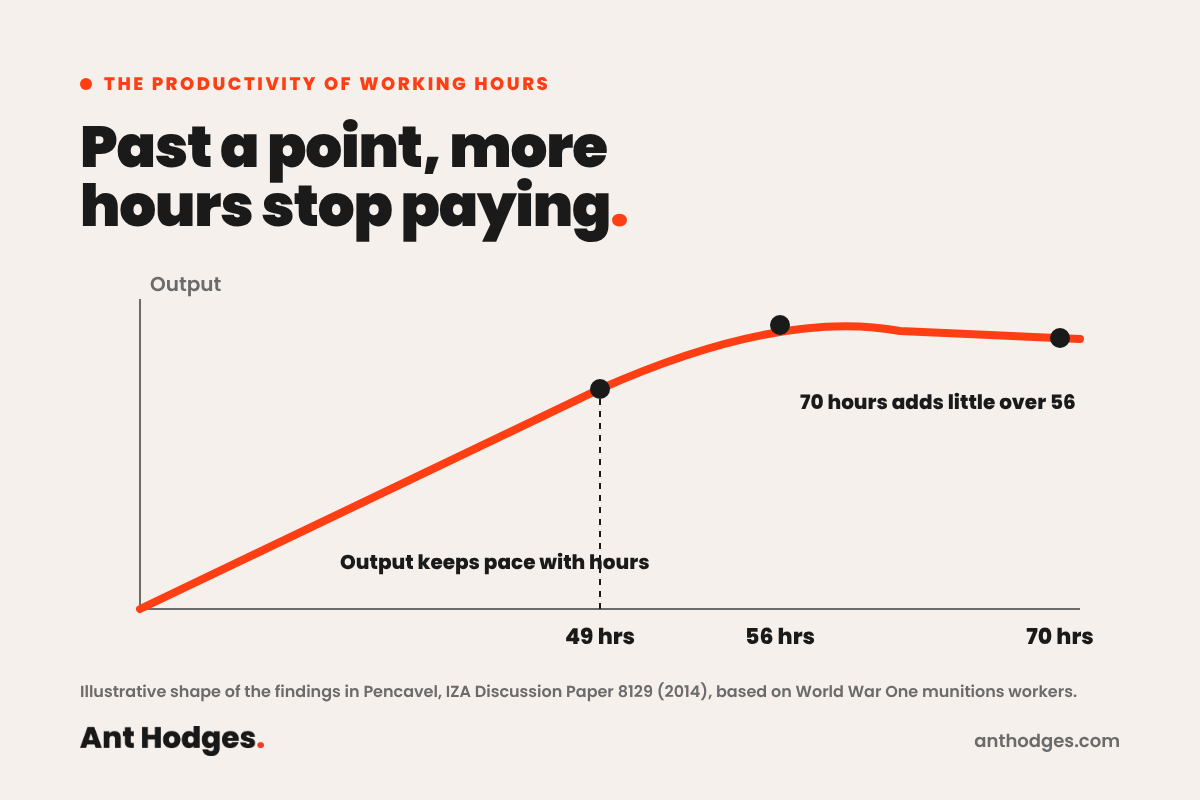
Then there are long hours. Economist John Pencavel of Stanford studied detailed records of munitions workers in the First World War. He found that output rose in line with hours up to a point of roughly 49 hours a week, then rose more slowly beyond it. Workers putting in 70 hours produced little more than those working 56.3 Those were factory workers more than a century ago, but the lesson carries over well. Extra hours stop paying for themselves long before most business owners stop working them.
Add those together and you get a hidden cost on every extra offer, platform and project you carry. The name I give it is the Complexity Tax.
Definition
The Complexity Tax
The Complexity Tax is a term coined by Ant Hodges, author of Simplify the Funnel®. It describes the hidden cost, in money, time, energy and buyer attention, of everything in a business that takes effort without producing results in proportion. It usually hides in five places: tools, offers, funnel steps, content volume and decisions.
The good news about a tax you've been paying without noticing is that you can stop paying it. Every item you remove gives you back a little time, a little money and a lot of mental space.
Can you work less and keep your revenue?
The most interesting real-world test of this idea came from the UK. In 2022, 61 companies with around 2,900 staff between them trialled a four-day week for six months, with no cut in pay. The results, published by the research group Autonomy with academics from Cambridge, Boston College and University College Dublin, surprised a lot of people.4
Revenue held steady across the trial. Among the companies that shared figures, revenue rose by 1.4% on average over the trial period, and it was 35% higher than the same period in previous years. Staff resignations fell by 57%, and 71% of employees reported lower levels of burnout. At the end, 56 of the 61 companies chose to carry on with the shorter week.4
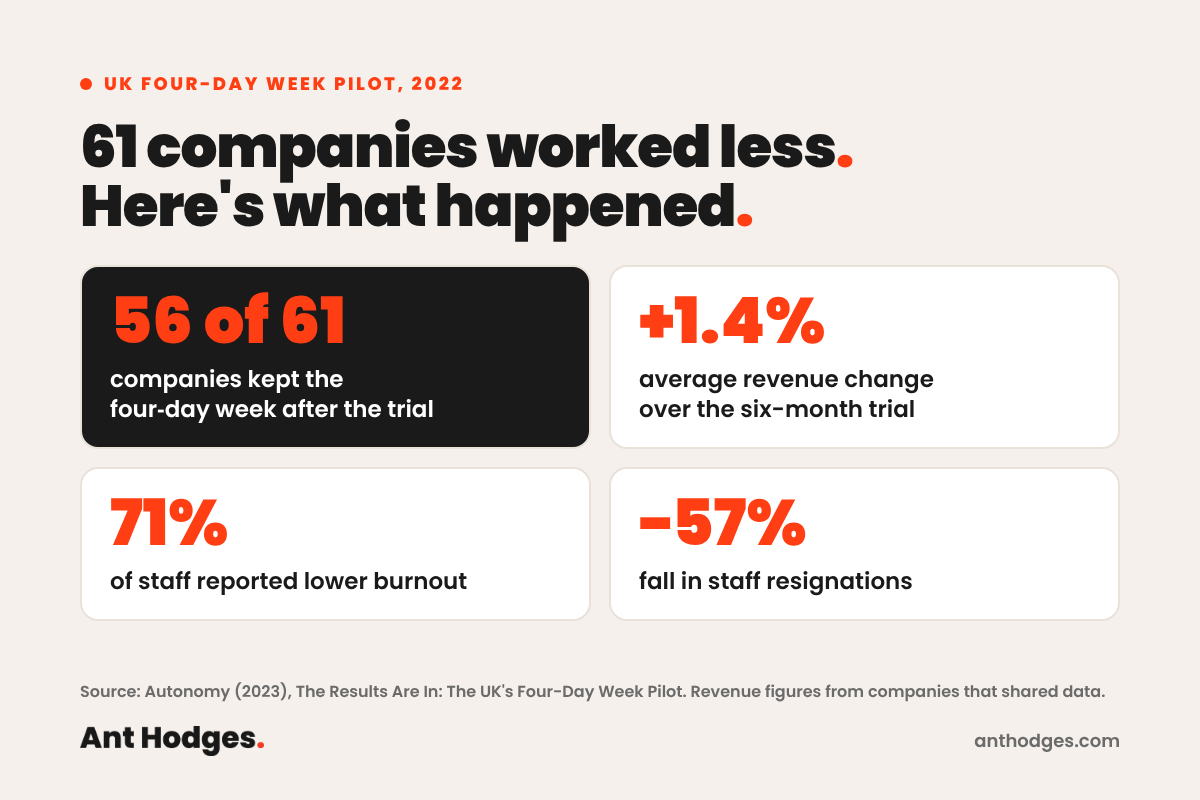
It's worth being careful with these numbers. Only around two dozen companies shared detailed revenue data, and the firms that volunteered were probably confident it would work. Even so, the direction is clear. Teams that cut out low-value work and protected their focus kept their revenue and gained a great deal of wellbeing.
A solo business owner or a small team can run the same experiment on a smaller scale. You don't need a four-day week to benefit. You need fewer things competing for the hours you already work.
In practice, that might mean one day a week with no calls at all, so you can do the deep work on your main offer. It might mean writing a month of content in a single session, instead of chasing a daily post across five platforms. Small changes like these give you back whole days without touching your income.
The pruning principle: why growth needs cutting back
A vineyard is the picture I come back to most often. Every winter, a grower cuts the vines right back, removing most of the previous year's growth. To someone walking past, it looks brutal. Yet that pruning is exactly what lets the vine put its energy into fewer, stronger branches, and that's where the best fruit comes from.
A business works the same way. Every offer, platform and project draws on the same root system, which is you. Cut back the branches that aren't bearing fruit, and the energy flows to the ones that are.
There's one part of pruning that people forget, and it's the dip. A freshly pruned vine looks smaller before it grows back stronger. My client's revenue fell from $22,000 to $18,000 in the first month before climbing past $40,000. That dip is normal, and knowing it's coming makes it much easier to hold your nerve.
Three things help you get through it well.
Tell your audience what's changing. A short, honest email explaining that you're focusing on your best work builds trust. Most people respect a business owner who knows what they're about.
Give the change a full 90 days. The dip usually shows up in the first month, while the growth takes a little longer to arrive. Judging the decision after three weeks means judging it at its lowest point.
Put the time you save straight back into the core. The hours that used to go on extra offers and platforms should go into improving your main offer, having more sales conversations and looking after the clients you already have. That's where the climb comes from.
Where should you start subtracting?
Start where the Complexity Tax is highest. For most online business owners, that's one of five places.
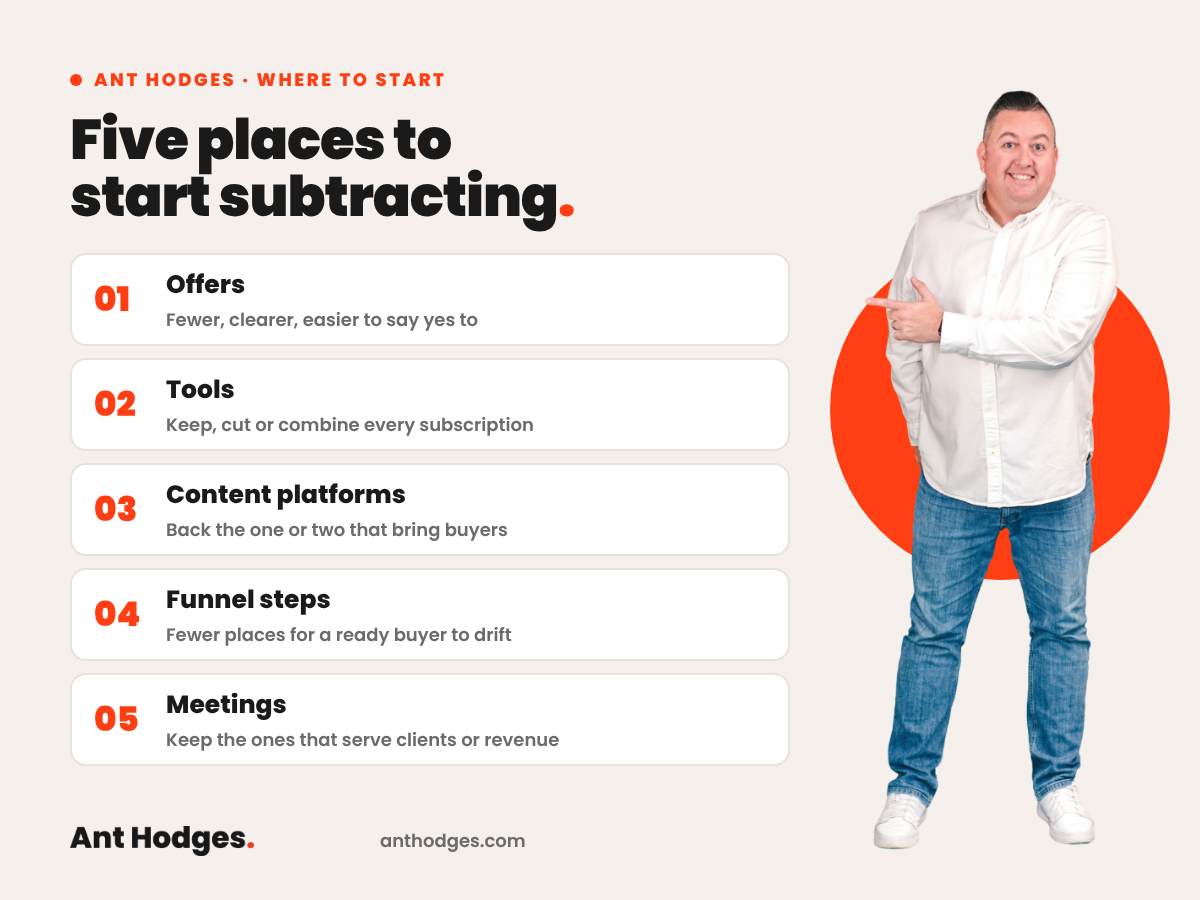
1. Look closely at your offers. How many do you sell, and could you combine them? If your audience regularly asks which one is right for them, that's a sign you have too many. Most businesses grow faster with one core offer and one smaller entry offer.
2. Look closely at your tools. List every subscription on your card statement. Mark each one keep, cut or combine. In one audit of my own, I found we were paying for three different video editing tools, because different people had signed up at different times. Cancelling the extras saved $2,400 a year in about five minutes.
The bigger wins tend to come from the bigger clear-outs. In a three-hour session with a solo business owner, we went through every subscription together and cancelled 23 of them, saving around $1,200 a month. Then we did one more simple thing. Their main program had been locked behind twice-yearly launches, so we made it available all the time and they told their email list. Within three days they had 11 new sales at $2,500 each, which is $27,500 from opening a door that had been kept shut.
3. Look closely at your platforms. Which one or two platforms actually bring you buyers? Give those your best work and let the rest rest.
4. Count your funnel steps carefully. Count the steps between someone finding you and buying from you. Each extra page, email or form is one more place a ready buyer can drift away.
5. Question your meetings and commitments. Look at next week's calendar and question every recurring commitment that doesn't serve a client or produce revenue.
The hardest part of all this is making the decision, and the doing is easy by comparison. Letting go of something you built or paid for takes a shift in thinking, and that shift is something I teach step by step in The Simplification Mindset training. To get access to the training I just mentioned, you can get instant access by joining my community.

How do you decide what to cut?
Most people know they need to cut something. The difficulty is choosing what, because everything on the list once seemed like a good idea.
The tool I use with clients is one I call the Simplification Decision Matrix. Every offer, tool, platform and recurring commitment gets two quick scores out of five. The first score is benefit: how much revenue, time or customer value it produces. The second is complexity: how much time, money, attention and upkeep it costs you.
Definition
The Simplification Decision Matrix
The Simplification Decision Matrix is a tool created by Ant Hodges for deciding what stays in a business. Each offer, tool, team task or commitment is scored for complexity against benefit, then given one of three outcomes: keep, kill or combine.
Once everything has its two scores, the decisions mostly make themselves.
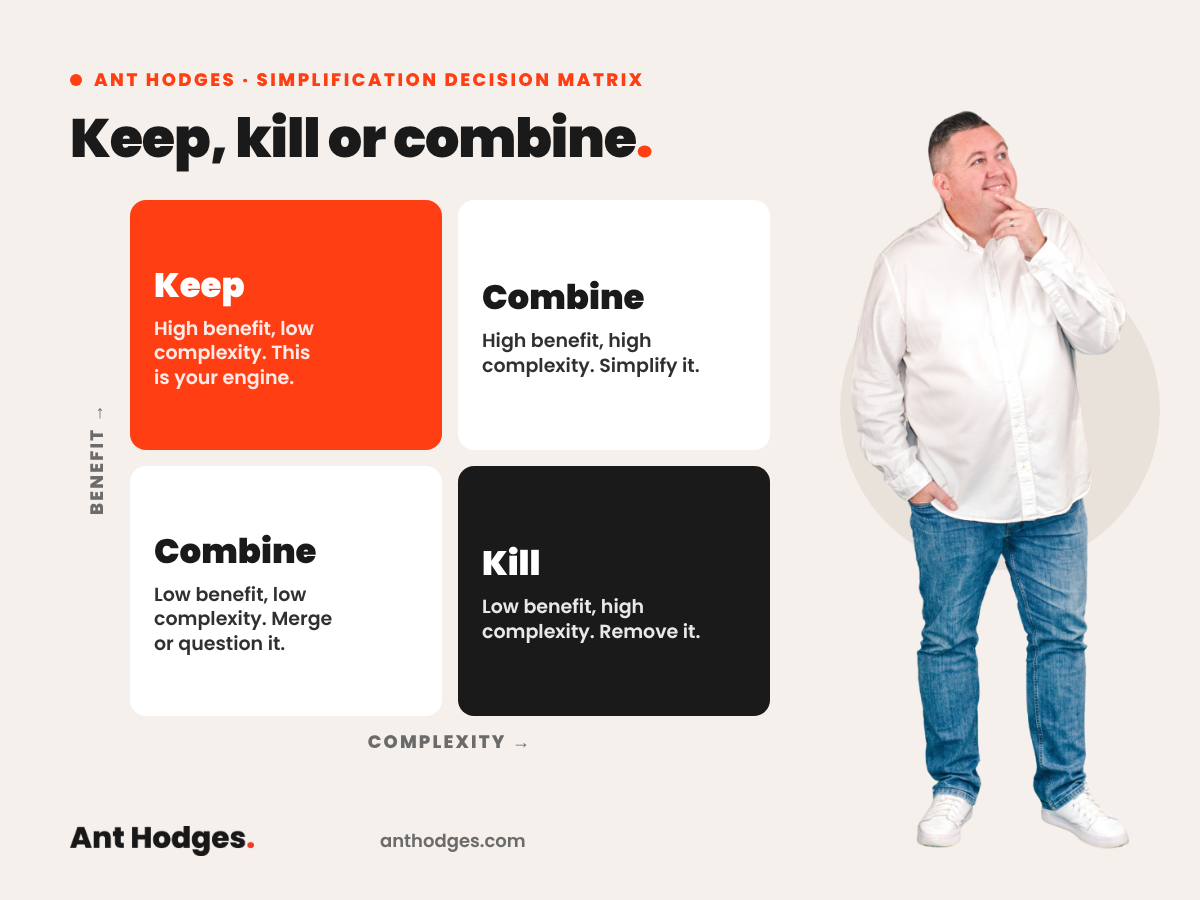
Keep the things with high benefit and low complexity. These are your engine, and they deserve more of your time.
Kill the things with low benefit and high complexity. They're the clearest examples of the Complexity Tax, and removing them usually feels like a weight lifting.
Combine or simplify everything in between. Two similar offers can become one stronger offer. Three overlapping tools can become one. Two weekly meetings can become one shorter one.
The scoring takes an hour or two the first time, and it's worth doing honestly. Ask yourself whether you'd start this thing today if you weren't already doing it. If the answer is no, that tells you most of what you need to know.
What happens when you only use what you already have?
One of my favourite examples of doing less came from a one-to-one session with an executive coach in 2023. She had invested heavily in a complex launch system, and six months in it still wasn't ready. There were dozens of videos left to record and a long list of email templates still to rewrite.
So I asked her to list what she already had. It turned out to be plenty. She had a following on LinkedIn and Instagram, a finished sales page for a $497 mini course, a recorded webinar, a community ready to open and an email list of 16,000 people who had never been offered anything to buy.
My suggestion to her was very simple. Send one email to the list today, offer the mini course, and include three months in the community as a bonus.
She sent that email, then a few more. In the month after we spoke, 54 people bought the mini course, which brought in $27,000. Over the next couple of months that grew to 203 paying customers.
When she was ready to open her $10,000 coaching program, we planned the launch in one hour. It used 10 emails to her list, two live webinars and one live Q&A, with no ads at all. Of her 203 existing customers, 127 upgraded, and six more people joined from the wider list. That launch brought in $1,330,000 in sales, most of it on payment plans.
She didn't need anything new. She needed permission to stop building and start using what was already in front of her. Here's how I put it in the book:
"Start small. Pick one area to simplify first. See the results. Then move on to the next."
From Simplify the Funnel®
The framework behind her launch, the Minimum Viable Funnel™, is the core of Simplify the Funnel®. It reduces your marketing to one traffic source, one entry offer, one conversion event and one core offer.

How do you stop the clutter creeping back?
Cutting back once is the easy part. The real skill is keeping the business lean as it grows, because new opportunities will keep arriving every week.
Before I add any new tool, offer or project, I ask myself four questions.
- Does this solve a real problem I'm having right now?
- Can I get the same result with what I already have?
- Will this genuinely improve my customer's experience?
- Do I have the capacity to set it up and keep it running?
If any answer is no, I let it pass. Most shiny things don't survive the four questions.
Then, every 90 days, I run a quick review. Every offer, tool, platform and recurring commitment gets checked against the revenue it produced. It takes an hour or two, and it stops the clutter quietly building up again.
Doing less means putting your full effort into the few things that deserve it, and enjoying the business you built a lot more as a result.
Try this today
The two-things question
- Block out one hour with a notebook, away from your desk.
- Ask yourself, "What would my business look like if I could only do two things?"
- Write down the two activities that produce most of your revenue.
- List everything else you do each week next to them.
- Pick one item from that list and stop doing it before Friday.
Frequently asked questions
Why does doing less make you more money?
Most small businesses earn the majority of their revenue from a few things: one strong offer, one channel that brings the right buyers and the conversations that turn interest into sales. Cutting back everything else frees time, energy and money for those things, and it makes buying simpler for customers.
What is the Subtraction Principle?
The Subtraction Principle is the rule that before adding anything new to your business, you should first ask what you can remove. It focuses on the offers, tools and activities that take time without being directly connected to revenue.
Will my revenue drop if I cut offers?
It might dip briefly while your audience adjusts. In one client's business, monthly revenue fell from $22,000 to $18,000 in the first month after simplifying, then reached $31,000 by month three and more than $40,000 by month six. Planning for a short dip makes it easier to stay the course.
Is there research showing that working fewer hours works?
Yes, and the evidence is encouraging. A UK trial of a four-day week across 61 companies found revenue held steady, staff resignations fell by 57% and 56 of the companies kept the shorter week. Earlier research by economist John Pencavel found that output grew more slowly once weekly hours passed about 49, and 70 hours produced little more than 56.
Where should I start simplifying my business?
Start with your offers, tools, content platforms, funnel steps and meetings, and remove one thing this week. If you'd like hands-on help, my Simplify Day is one focused day where we simplify your offer, map one clear path to a sale and write a 90-day plan you can follow.

About Ant Hodges
Ant Hodges is the author of Simplify the Funnel®, a Kajabi Founder and the host of the Less Is The Strategy podcast. He has spent more than 20 years running his own businesses, agency and programs, and now helps online business owners, coaches, creators and experts simplify their businesses and leave the cult of hustle behind.
Footnotes
- Adams, G. S., Converse, B. A., Hales, A. H. and Klotz, L. E. (2021) "People systematically overlook subtractive changes." Nature, 592, 258-261, 7 April 2021. Summary free to read, full article for subscribers. nature.com/articles/s41586-021-03380-y ↩
- American Psychological Association (2006) "Multitasking: Switching costs." APA, 20 March 2006. apa.org/topics/research/multitasking ↩
- Pencavel, J. (2014) "The Productivity of Working Hours." IZA Discussion Paper No. 8129, April 2014. docs.iza.org/dp8129.pdf ↩
- Lewis, K., Stronge, W., Kellam, J. and Kikuchi, L. (2023) "The Results Are In: The UK's Four-Day Week Pilot." Autonomy, February 2023. autonomy.work (PDF) ↩
All sources were checked and live at the time of writing.