What a Fractional CMO Does for a $5M Business in 2026
Jun 23, 2026
In August 2023, I spent a few days alone in Porto with a phone full of photos. Before leaving, I'd covered an office wall in sticky notes, one idea or funnel step on each, and photographed the lot to take with me. Those days went on looking back over the projects and clients my agency had worked with. Over 20 years, that work had generated more than $76 million in sales for clients, and I wanted to understand what had really produced it.
The pattern was hard to miss. The businesses that grew fastest were the ones willing to simplify. They had one clear offer, one main channel and someone senior keeping everyone focused on it. The expensive misses looked busy, with lots of channels, lots of activity and nobody holding the whole plan together.
That lesson sits at the centre of this guide. A business doing around $5 million a year has usually outgrown founder-led marketing, yet it often doesn't need a full-time Chief Marketing Officer. A fractional CMO fills that gap, and more owners than ever are asking what one actually does.
This post answers that question properly. You'll see what the role covers, what the research says about budgets and hiring, how it compares with a full-time hire or an agency, the four moves I make in the first 90 days, and a simple test for whether your business is ready.
The short answer
A fractional CMO is a senior marketing leader who works part time inside your business, setting the strategy, choosing the priorities and leading the team you already have. For a $5 million business, the biggest value is focus: fewer channels, one clear customer path and marketing decisions taken off the founder's desk. A business this size typically spends somewhere between $385,000 and $470,000 a year on marketing, so senior direction on that money matters. The model fits best when marketing needs leading but doesn't yet need a full-time executive.
In this post
- What is a fractional CMO?
- Why are more businesses hiring fractional CMOs?
- What does a fractional CMO do for a $5M business?
- How much should a $5M business spend on marketing?
- The four moves I make in the first 90 days
- Fractional or full-time CMO: which does a $5M business need?
- How is a fractional CMO different from an agency?
- What should you look for in a fractional CMO?
- How do you know your business is ready?
- Where does AI fit in a fractional CMO's plan?
- Try this today: your one-week CMO review
- Frequently asked questions
What is a fractional CMO?
A fractional CMO is a Chief Marketing Officer who works with your business for part of their time, usually on a monthly agreement or a fixed engagement. They do the senior part of the job. They decide where marketing effort goes, set the priorities, hold the team to them and report to you on what's working.
The word "fractional" simply means you get a fraction of their week. You still get the full depth of their experience, because the role is built around judgement rather than hours at a desk.
Researchers writing in Harvard Business Review describe the appeal clearly. Part-time senior leaders let a company bring in executive experience without the cost and commitment of a full-time hire, and the people doing this work typically bring 20 to 30 years of experience with them.1
That last point matters for a business at $5 million. Your marketing doesn't need someone learning on the job. It needs someone who has seen many versions of your situation before and can tell quickly which few things will move revenue.
Most engagements follow a similar rhythm. There's an audit at the start and a written plan, followed by regular sessions with the founder and the team, often monthly or fortnightly. Many fractional CMOs also give direct access in between for decisions that can't wait, and work in 90-day sprints so the plan is reviewed and reset every quarter.
Why are more businesses hiring fractional CMOs?
Fractional leadership has moved from a niche arrangement to a normal one. Revelio Labs, which analyses workforce data, tracked how often new executive positions mentioned fractional work. In 2018 it was 5 in every 1,000 new executive roles, and by 2024 that had risen to 18 in every 1,000, with the biggest jump between 2021 and 2023.2
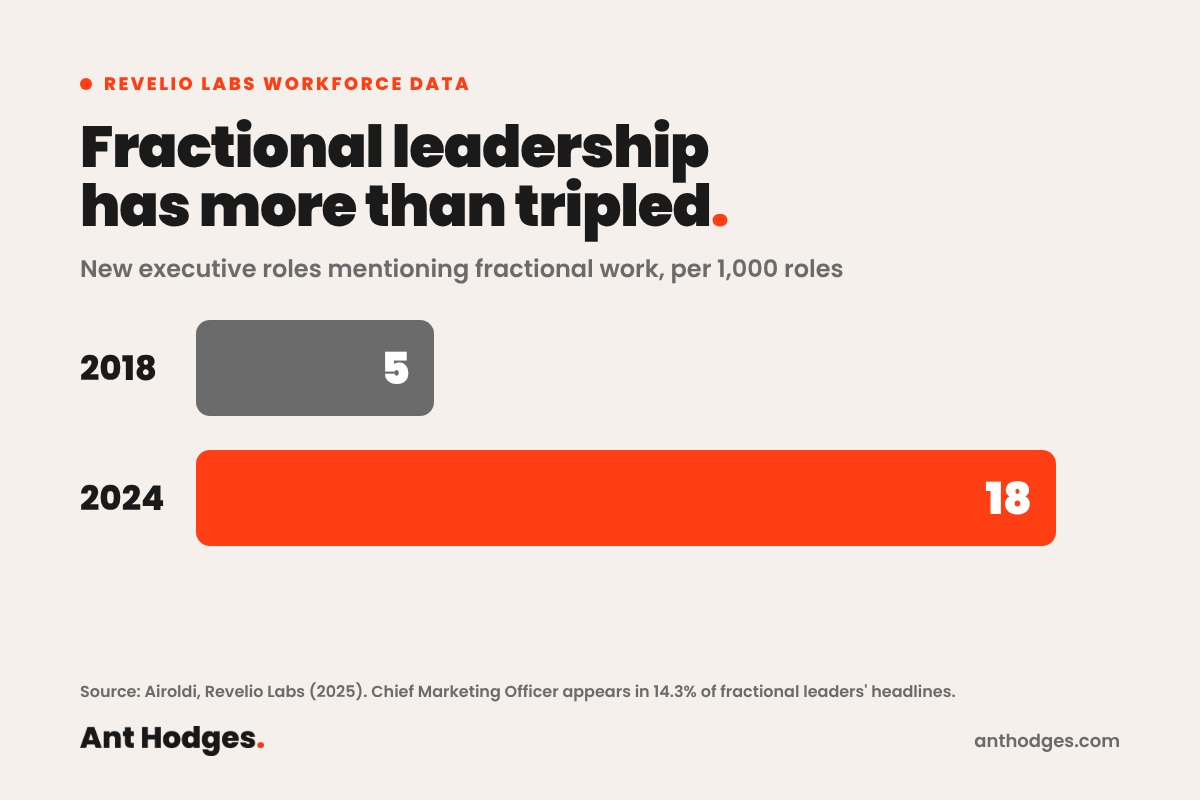
Marketing is one of the biggest parts of that shift. In the same analysis, Chief Marketing Officer was one of the most common titles among fractional leaders, appearing in 14.3% of their profile headlines.2
The reasons are easy to see from both sides. Experienced marketing leaders want more control over how and with whom they work. Growing businesses want that experience in a form they can afford and adjust as they grow. For a company between $1 million and $10 million in revenue, that combination often fits better than a full-time executive search.
What does a fractional CMO do for a $5M business?
The honest answer is that a good fractional CMO does fewer things than most people expect, and does them well. At $5 million, the work usually falls into five areas.
1. They set one clear strategy. That means a clear audience, a clear core offer and a short list of channels that deserve investment. Everything else gets parked for now.
2. They own the marketing budget. They decide where the money goes each quarter and, just as importantly, where it stops going.
3. They lead your existing team. Your marketing manager, your freelancers and any agencies all work to one plan, with one person setting direction.
4. They connect marketing to revenue. Every activity gets tied to a number that matters, such as qualified leads, sales conversations or revenue from a specific offer.
5. They take marketing decisions off the founder's desk. In many businesses this size, the founder is still the unofficial CMO. They come up with the ideas, run the meetings and approve every campaign, while the team reports on activity and the numbers stay flat.
That fourth area is where senior leadership earns its keep. The CMO Survey, which has tracked marketing leaders in the US for more than a decade, found that the top challenge marketing leaders report is showing how their work affects financial results, cited by 64%.3 A fractional CMO's first job is to close that gap, so you can see which parts of your marketing produce money and which parts just produce activity.
How much should a $5M business spend on marketing?
Most owners underestimate how much they already spend. Two large surveys give a useful range.
Gartner's 2025 CMO Spend Survey found that marketing budgets held at 7.7% of company revenue, the same as the year before.4 Most of those companies were large, with annual revenue above $1 billion. The CMO Survey's 2025 report put the average across its respondents a little higher, at 9.4% of company revenue.3
Apply those figures to a $5 million business and the numbers get real very quickly.
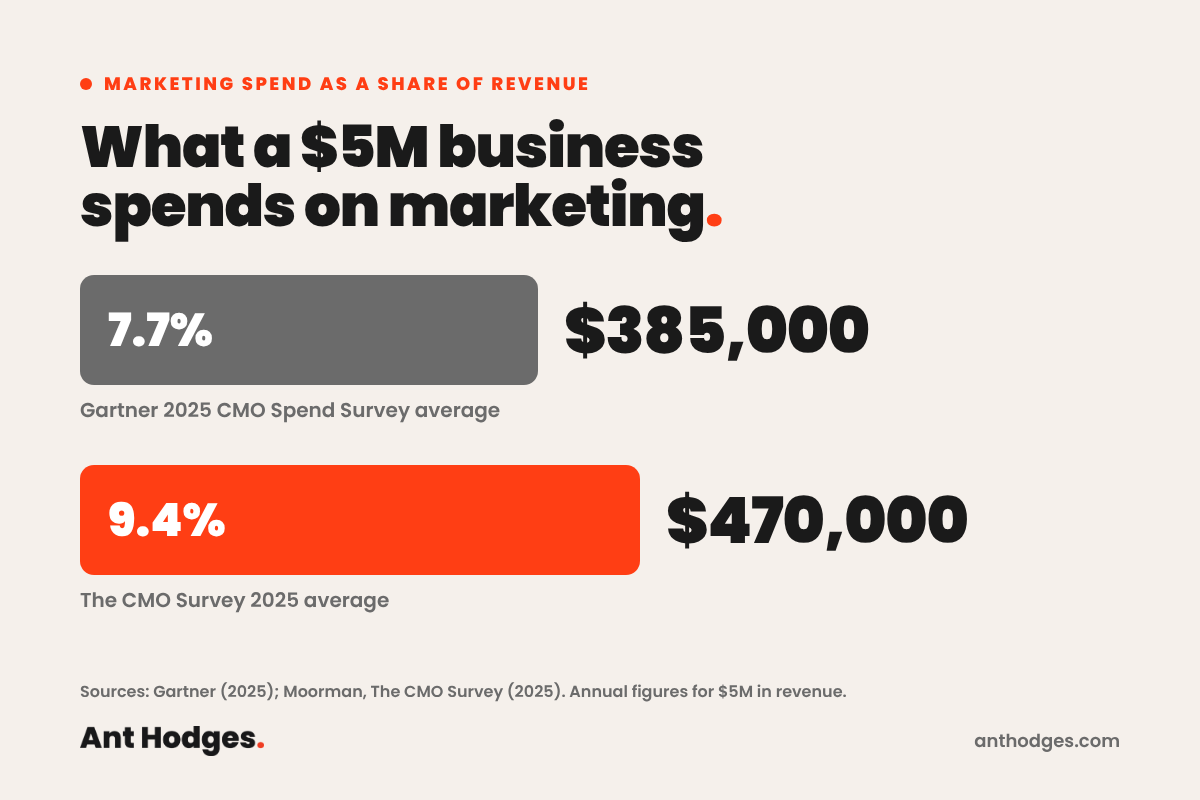
At 7.7%, that's $385,000 a year. At 9.4%, it comes to $470,000. Once you add salaries, freelancers, software, ads and agency fees, plenty of businesses at this level land somewhere in that range without ever deciding to.
So the useful question is rarely whether to spend more. It's whether the money you already spend is pointed at the few things that work. When it's spread across too many channels, tools and campaigns, you're paying a hidden cost, and that cost has a name. The name I give it is the Complexity Tax.
Definition
The Complexity Tax
The Complexity Tax is a term coined by Ant Hodges, author of Simplify the Funnel®. It describes the hidden cost, in money, time, energy and buyer attention, of everything in a business that takes effort without producing results in proportion. It usually hides in five places: tools, offers, funnel steps, content volume and decisions.
In a $5 million business, the tax tends to show up as overlapping software, campaigns nobody measures, too many offers on the website and a team pulled in six directions at once. A fractional CMO's job is to find it and refund it, before asking for a single extra dollar.
Here's how I put it in the book:
"This audit might feel painful, but it's necessary. I've seen clients discover they were spending thousands on tools and systems that produced zero sales."
From Simplify the Funnel®
The four moves I make in the first 90 days
Over two decades of leading marketing inside other people's businesses, my approach has settled into four moves. They run in order, and each one makes the next one easier.
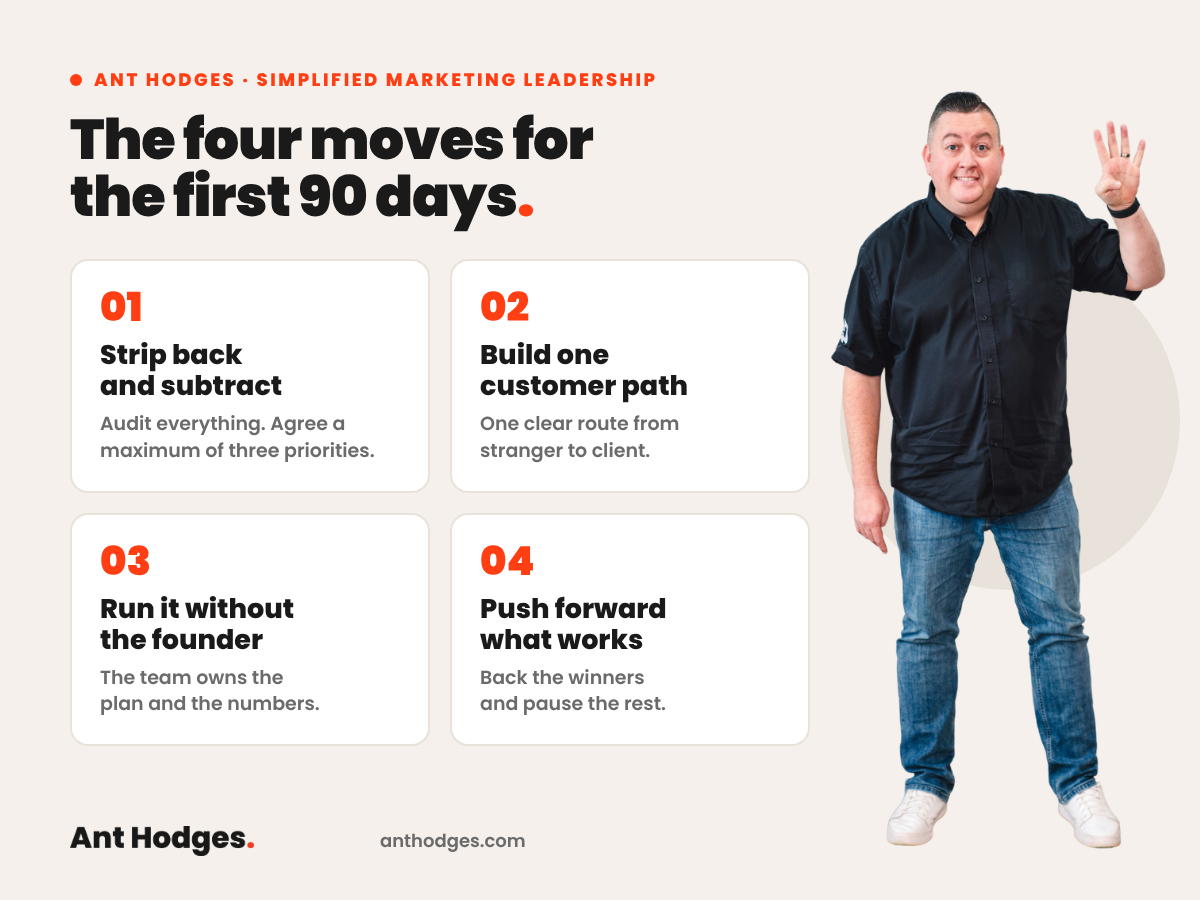
Move 1: Strip back and subtract
We start with what already exists. Every channel, campaign, tool, offer and recurring meeting goes on one list, next to the numbers it produced last quarter. Then we agree a maximum of three priorities that will actually move revenue. Everything else is paused, combined or cut.
This step nearly always surprises owners. The things that feel essential because they're busy are often the things producing the least, and the quiet channel nobody talks about is often doing most of the work.
Move 2: Build one customer path
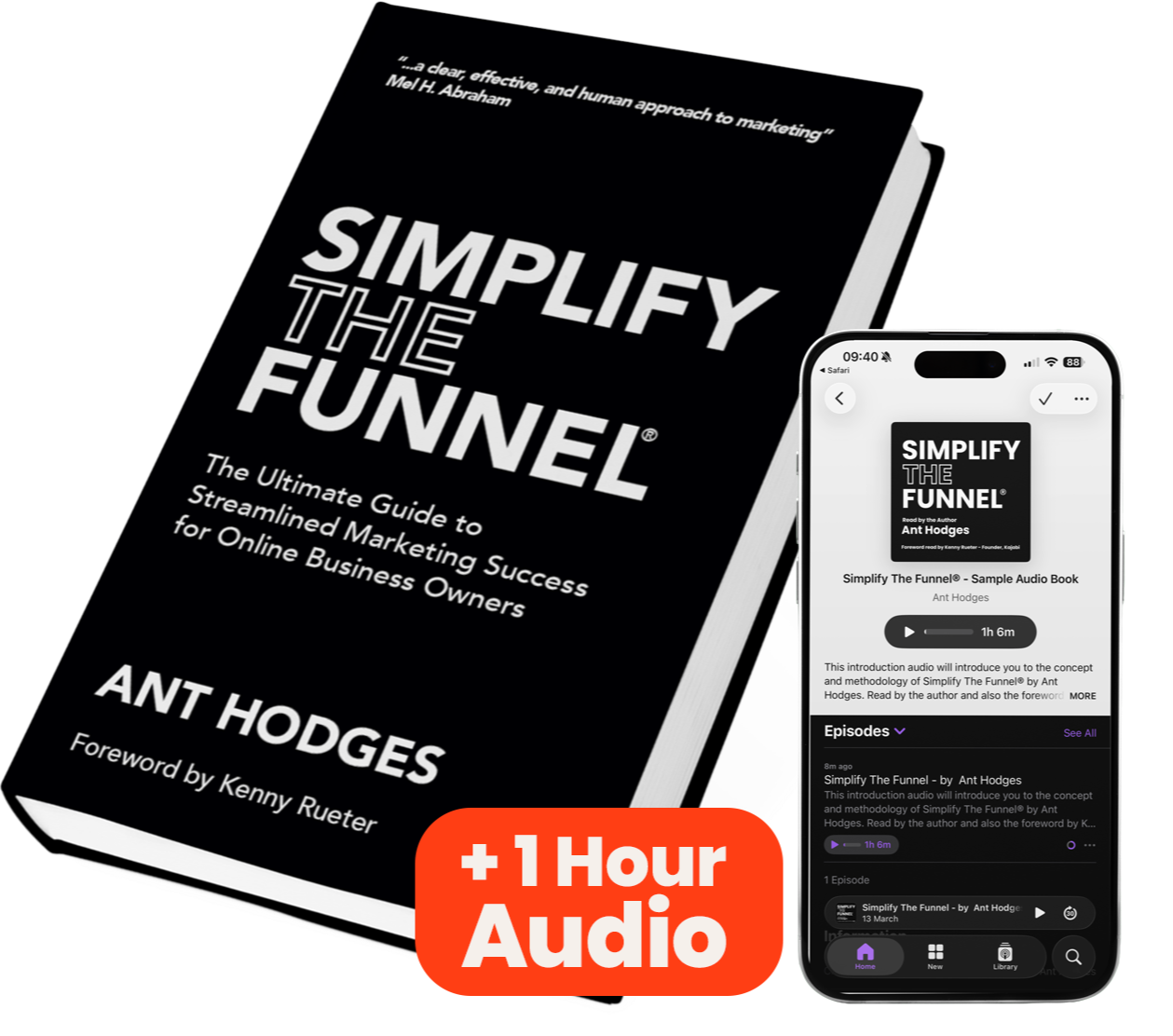
Next, we build one clear path from stranger to client. This is the thinking behind the framework at the heart of my book, which I call the Minimum Viable Funnel™.
Definition
The Minimum Viable Funnel™
The Minimum Viable Funnel™ (MVF) is a four-part marketing framework created by Ant Hodges and taught in his book Simplify the Funnel®. It reduces a business's marketing path to one traffic source, one entry offer, one conversion event and one core offer, so owners can launch quickly and see clearly what is working.
A $5 million business can run more than one path to a sale, of course. Starting with one gives everyone a shared picture of how a sale actually happens, and it shows you exactly where to look when the numbers dip.
One story from the book shows how much focus can do. James runs a financial planning firm in Salt Lake City, and his ads kept getting rejected in a crowded market. Instead of fighting that, we picked one channel he already had: business contacts who served the same people he did. After an accounting firm presented to his audience, he ran a return webinar for theirs, and that single webinar brought in 312 qualified leads, more than his previous 10 webinars combined. A three-person, commission-only sales team then sold 89 places on his $1,997 Family Financial Planning program in just under two weeks. After paying them 35%, he still banked $115,526.45, with no ad spend at all.
The full framework, with templates and examples, is in Simplify the Funnel®.

Move 3: Run it without the founder
Once the plan and the path are clear, the team takes ownership. Every person knows their priorities, the handful of numbers they're responsible for and who makes which decision. The founder moves from approving everything to reviewing a short report once a week.
For many owners, this is the move that changes their life as well as their business. Marketing stops queuing behind their inbox, and they get back the hours they were spending as an unofficial CMO.
Move 4: Push forward what works
After the first few weeks, the data starts to speak. That's the moment to put more behind the winners and less behind everything else.
In the book, I share the story of Sarah, who teaches art classes online. She was about to launch on three new platforms at once, because a social media marketer had sold her the idea at a women's business breakfast. We doubled down on Instagram instead, the channel already bringing her buyers, with a couple more posts each week plus more videos and carousels. Her audience grew from 3,200 to 12,000 in four months, and her sales rose by 67%.
The principle scales up neatly. As a rule, add a new channel only when your current ones are consistently delivering, and give each new one three months of focused effort before you judge it.
Put together, the four moves give the first 90 days a simple shape.
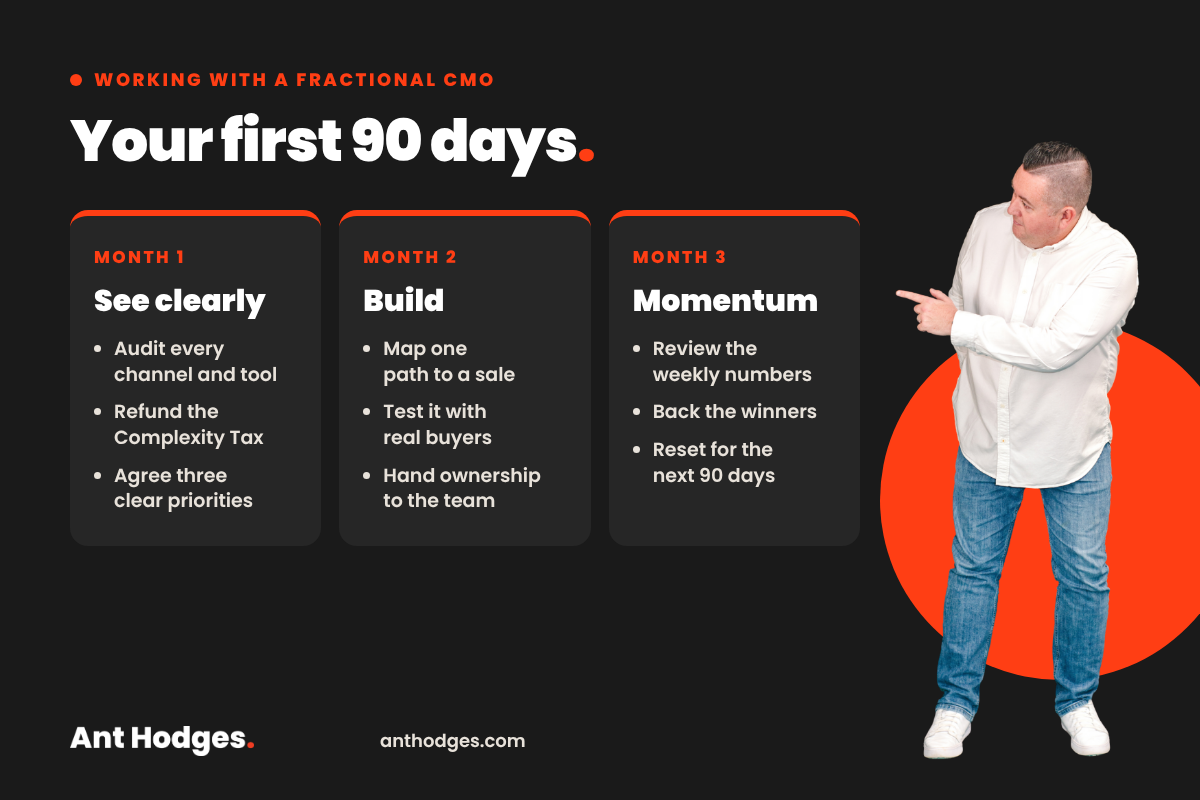
Month 1 is about seeing clearly. Everything gets audited, the Complexity Tax gets refunded, and the team agrees a maximum of three priorities. Most owners feel lighter by the end of this month, even before the numbers move.
Month 2 is about building. One clear path from stranger to client gets mapped, tested and handed to the team, with each person owning a small set of numbers.
Month 3 is about momentum. The weekly numbers show which parts of the path are working, and the budget follows the winners. At the end of the quarter, the plan is reviewed and reset for the next 90 days.
Fractional or full-time CMO: which does a $5M business need?
A full-time CMO is the right choice for some businesses. If marketing is your main growth engine, your team is large and you need someone in the building every day, a permanent executive makes sense.
For most businesses at $5 million, the numbers point the other way. The US Bureau of Labor Statistics puts the median pay for marketing managers, the level below the C-suite, at more than $160,000 a year.5 A Chief Marketing Officer sits above that, and benefits, bonuses and often equity come on top.
The role is demanding even at the very top. Executive search firm Spencer Stuart found that the average CMO at an S&P 500 company stays in post for 4.1 years.6 Those are the largest companies in America, with the deepest budgets and the biggest teams.
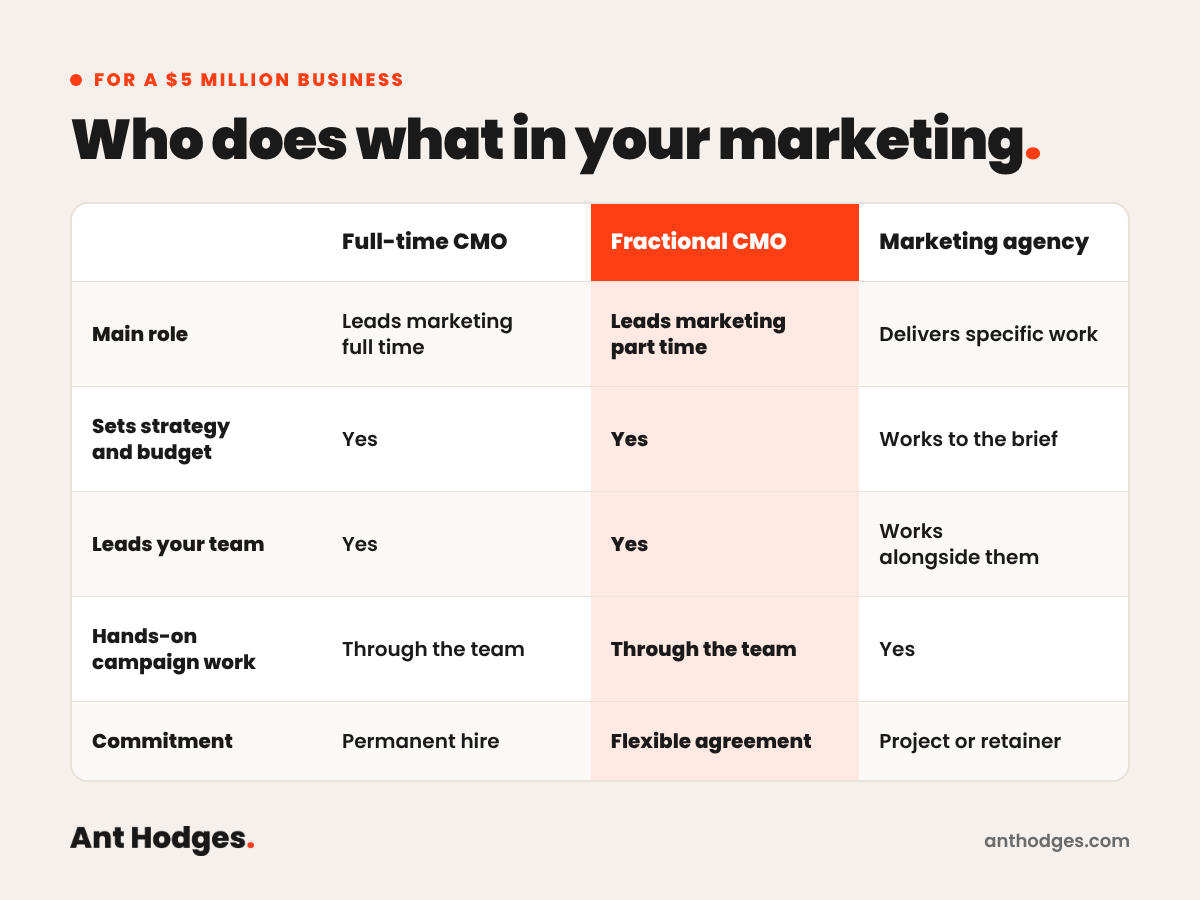
A fractional arrangement gives a growing business the senior thinking without locking in a permanent executive salary. You can scale the relationship up or down as the business changes, and once the systems are running well, a capable marketing manager can often carry them forward.
How is a fractional CMO different from an agency?
This is one of the most common questions I get, partly because I ran agencies for many years. The two roles work best together, and they do different jobs.
A fractional CMO leads the marketing. They decide the strategy, choose the channels, set the budget and judge the results. An agency executes the work. It builds the ads, writes the content or runs the campaigns that the strategy calls for.
Without that leadership, agencies end up taking direction from a busy founder, or setting the strategy themselves around the services they sell. With it, they get a clear brief and a clear measure of success. That clarity matters even more now, as Gartner found that 39% of marketing leaders planned to cut their agency budgets in 2025.4 When budgets tighten, the agencies that stay are the ones whose work is plainly tied to revenue.
For a $5 million business, a simple model works well. One senior person sets direction, your in-house team handles the daily work, and specialist agencies or freelancers fill the gaps.
What should you look for in a fractional CMO?
A fractional CMO will sit close to the heart of your business, so the fit matters as much as the CV. These are the five qualities I'd look for if I were hiring one for a $5 million business.
1. They have experience at your stage. Leading marketing for a $5 million company is very different from leading it at a global brand. Look for someone who has worked inside businesses of a similar size, with similar teams and budgets.
2. They have a bias for subtraction. In your first conversation, listen for what they want to remove. Strong marketing leaders usually find savings and focus before they ask for new spending.
3. They lead your team well. The best fractional CMOs make your existing people better. They coach, set clear priorities and leave the team stronger when the engagement ends.
4. Everything ties back to revenue. Ask how they'll report progress. You want a short list of numbers connected to sales, reviewed on a regular rhythm, so you always know what's working.
5. They're honest about the fit. A good fractional CMO will tell you when you're not ready, or when a smaller step would serve you better. That honesty is usually a sign of how they'll lead.
A few questions help bring all five into the open. What would you remove from our marketing first? How will we know in 90 days whether this is working? Who on my team will own each part of the plan? How will we make decisions when you're not in the room?
How do you know your business is ready?
You're probably ready for senior marketing leadership when several of these sound familiar.
- Your team is busy, but you can't say which activity produces most of your sales.
- You're still making marketing decisions that someone more senior should own.
- You have more offers, channels or tools than you can explain in one minute.
- Your marketing spend has grown, and your confidence in it hasn't grown with it.
- You sense there's a simpler, sharper version of your marketing waiting to be built.
The fifth sign is the one I hear most often, and it's usually right. Growth at this stage rarely comes from adding. It comes from removing what doesn't work and putting real weight behind what does.
Simplifying is as much a mindset as a method, and it's the part most leaders find hardest. The thinking behind it is something I teach, step by step, in The Simplification Mindset training. To get access to the training I just mentioned, you can get instant access by joining my community.

Where does AI fit in a fractional CMO's plan?
Every owner I speak to in 2026 asks about AI, and it deserves a clear answer. My own view on it is simple. AI belongs in the back office, and people belong at the front.
In the back office, AI can save a marketing team real hours. It helps with research, reporting, summarising sales calls, tidying data and producing first drafts of internal documents. That's time your team gets back for the work that needs a human.
At the front, your buyers should meet real people. The sales conversation, your content in your own words, the follow-up after a great call and the care you show existing clients all build the trust that keeps people buying. A business at $5 million has usually grown because people trust the founder and the team, and that trust is worth protecting.
A good fractional CMO will map where each part of your marketing sits. The repeatable, behind-the-scenes work gets faster and cheaper. The human moments get more time and attention, which is exactly where a simpler business wants its energy to go.
Try this today
Your one-week CMO review
- List every marketing channel, campaign and tool, with what each one produced last quarter.
- Circle the one channel that brought in the most revenue for the least effort.
- Draw your path from stranger to client on a single page.
- Choose a maximum of three marketing priorities for the next 90 days.
- Hand one marketing decision you currently make to someone on your team.
Frequently asked questions
What is a fractional CMO?
A fractional CMO is a senior marketing leader who works with a business part time, usually on a monthly or fixed-term agreement. They set the marketing strategy, choose the priorities, own the budget and lead the existing team, giving a growing business executive-level direction without a full-time executive salary.
How much should a $5 million business spend on marketing?
Large surveys put average marketing spend at around 7.7% to 9.4% of company revenue, which is $385,000 to $470,000 a year for a $5 million business. The right figure depends on your market and margins. Focusing that spend on the few channels that produce revenue usually matters more than the total.
Do I need a fractional CMO or a marketing agency?
The two roles do different jobs. A fractional CMO decides the strategy and leads the work, while an agency carries out specific tasks such as ads or content. Many businesses at $5 million use both, with the CMO setting the direction and the agency delivering against a clear brief.
How long does it take a fractional CMO to make a difference?
Most of the early value comes in the first 90 days, when the existing marketing is audited, priorities are cut to a maximum of three and one clear path from stranger to client is built. Results from new channels take longer, so give each channel around three months of focused effort before judging it.
Where should I start if my marketing feels scattered?
Start with the one-week CMO review above, and cut your priorities to three. If you'd like to work through it with me, my Simplify Day is one focused day where we simplify your offer, map one clear path to a sale and write a 90-day plan your team can follow.

About Ant Hodges
Ant Hodges is the author of Simplify the Funnel®, a Kajabi Founder and the host of the Less Is The Strategy podcast. He has spent more than 20 years running his own businesses, agency and programs, and now helps online business owners, coaches, creators and experts simplify their businesses and leave the cult of hustle behind.
Footnotes
- Yokoi, T. and Bonsall, A. (2024) "How Part-Time Senior Leaders Can Help Your Business." Harvard Business Review, 2 July 2024. Summary free to read, full article for subscribers. hbr.org/2024/07/how-part-time-senior-leaders-can-help-your-business ↩
- Airoldi, A. (2025) "Everyone Needs a Side Hustle These Days - Even Executives." Revelio Labs, 11 March 2025. reveliolabs.com/news/business/everyone-needs-a-side-hustle-these-days-even-executives ↩
- Moorman, C. (2025) "The CMO Survey: Highlights and Insights Report 2025." The CMO Survey, March 2025. cmosurvey.org (PDF) ↩
- Gartner (2025) "Gartner 2025 CMO Spend Survey Reveals Marketing Budgets Have Flatlined at 7.7% of Overall Company Revenue." Gartner press release, 12 May 2025. gartner.com/en/newsroom ↩
- US Bureau of Labor Statistics (2025) "Advertising, Promotions, and Marketing Managers." Occupational Outlook Handbook. bls.gov/ooh/management/advertising-promotions-and-marketing-managers.htm ↩
- Adams, P. (2026) "CMO-plus roles more prominent as marketing needs diversify: report." Marketing Dive, 26 January 2026, reporting Spencer Stuart's annual CMO tenure research. marketingdive.com/news/cmo-plus-roles-more-prominent-as-marketing-needs-diversify-report ↩
All sources were checked and live at the time of writing.